

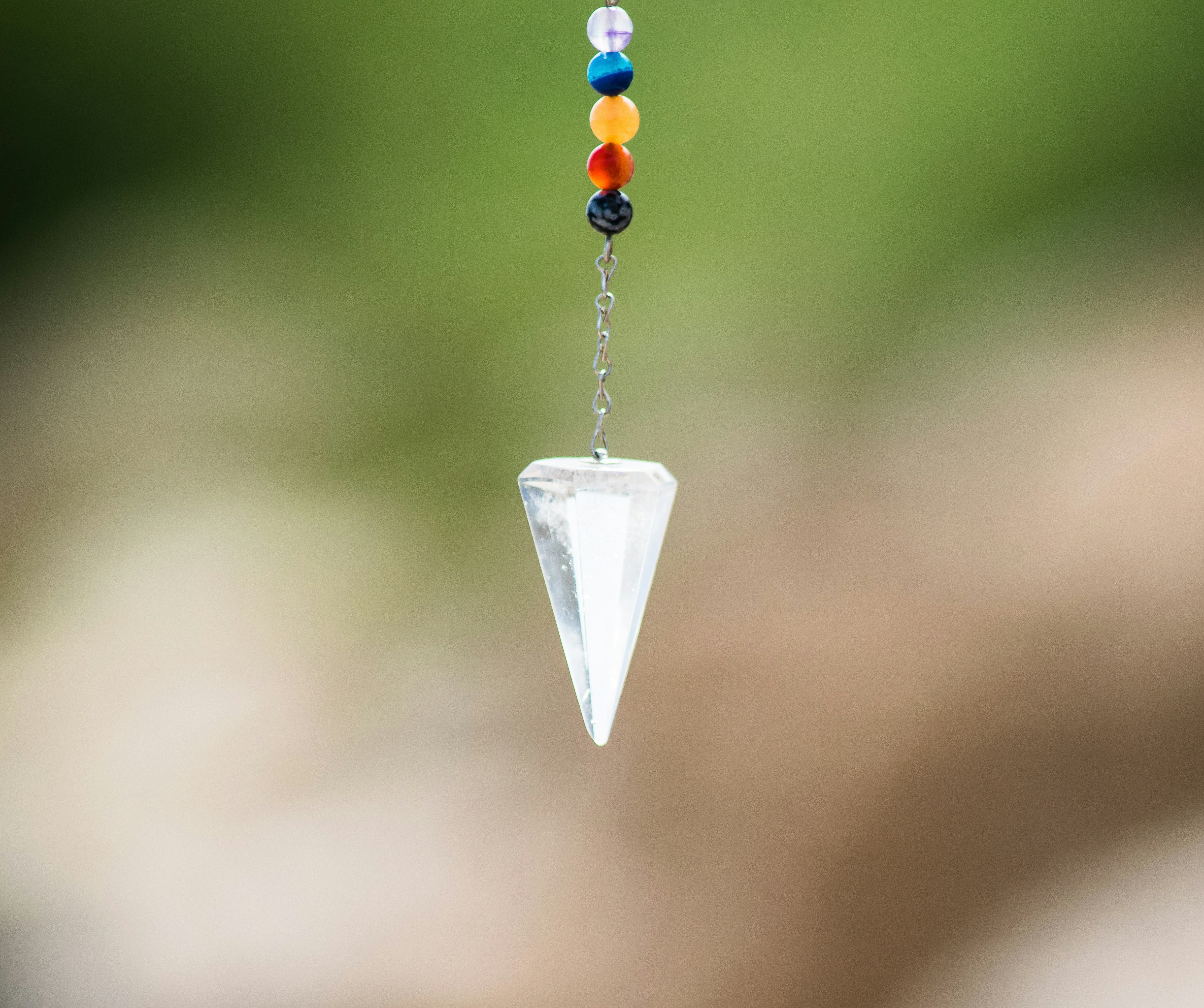
Have you ever felt torn between two choices — one part of you saying yes, the other unsure — and wished for something that could just point you in the right direction? That quiet tug of intuition is where pendulum divination finds its place. It’s not about fortune-telling or predicting your future. It’s about learning to listen to the body’s natural signals and translating them into motion you can see.
The pendulum, sometimes referred to as a dowsing pendulum, has roots that reach back centuries. In ancient times, dowsers used pendulums to locate water sources, minerals, or hidden objects — long before maps and machines existed. In various cultures, the pendulum was also seen as a bridge between the physical and the unseen, a way to access answers from intuition, spirit, or energy fields that can’t be measured but are certainly felt. Today, pendulums are often used for spiritual insight, energy work, or personal guidance, serving as a simple yet powerful extension of your intuition.
At its core, a pendulum is nothing more than a weighted object suspended from a chain or string. It could be a crystal, a metal point, or even a key tied to a piece of thread. What makes it special isn’t its appearance but the sensitivity it has to subtle energy shifts — both in your environment and within you. The motion of the pendulum reflects these tiny movements, giving you a way to “see” what your body or energy already knows.
Historically, pendulums were viewed as practical tools. Farmers and explorers once relied on them to find underground water, miners used them to detect veins of metal or gems, and healers used them to locate energy imbalances in the body. The process was simple: hold the pendulum steady, ask a question, and observe its motion. Over time, the practice evolved from locating physical sources to uncovering emotional or spiritual ones.
Today, pendulum divination has become more personal and introspective. You might see someone holding a pendulum over a map, tarot spread, or even a chakra chart, seeking direction or confirmation. Others keep it in their meditation corner, using it to check their energy or make intuitive decisions. It’s a versatile practice that can be as simple or as in-depth as you want it to be.
If you’ve never used a pendulum before, here’s where to start. Choose one that feels right for you. It doesn’t have to be fancy — clear quartz, amethyst, metal, or even a pendant on a string will do. Sit quietly in a comfortable position, holding the pendulum between your thumb and forefinger, allowing it to hang freely. Take a few deep breaths to ground yourself. The key here is calm focus; your energy should feel centered.
Next, ask your pendulum to show you its “yes” and “no.” Watch closely. A “yes” might appear as a forward-and-back motion, while “no” might swing side to side — though this can vary for each person. Once you’ve established your signals, start with easy, factual questions to confirm accuracy (“Is my name ___?”). This helps build trust in the process. As you grow more comfortable, you can begin asking gentle, open-ended questions — not to control outcomes, but to understand what feels aligned.
Pendulum divination works best when your mind is clear, and your heart is steady. If you’re anxious, distracted, or trying too hard to force answers, the pendulum will often reflect that confusion. That’s why grounding is so important — take a moment to breathe, visualize roots extending from your feet, and only then begin. The pendulum isn’t an external oracle; it’s an extension of your awareness.
In our modern world, where decisions are made at lightning speed, tools like the pendulum can help you slow down and reconnect with your intuition. You might use it to choose between projects, clarify intentions, or even check in with how you’re feeling. For instance, before a big meeting or conversation, you could ask: “Is this the right time to bring this up?” The motion might surprise you, but it will often match what your gut already knows.
Beyond yes-or-no questions, some people use pendulums for energy healing or spiritual clearing. In these cases, the pendulum is held over the body or chakras to sense imbalances or blocked energy. A steady or erratic swing can show where more attention is needed. Others use it to pick crystals, affirmations, or even foods that best support their energy that day. The pendulum becomes a gentle partner in daily self-awareness.
The beauty of this tool lies in its simplicity. You don’t need special training or elaborate rituals. You just need a moment of quiet and an open mind. Over time, working with a pendulum can deepen your trust in yourself — because each answer it gives, no matter how subtle, is ultimately coming from within you.So the next time you’re facing a choice, feeling uncertain, or just want to connect with your intuition, take a moment. Sit still, breathe, and let the pendulum swing. It’s a reminder that sometimes, all the clarity we need is already present — waiting to move, gently, in the direction of truth.