

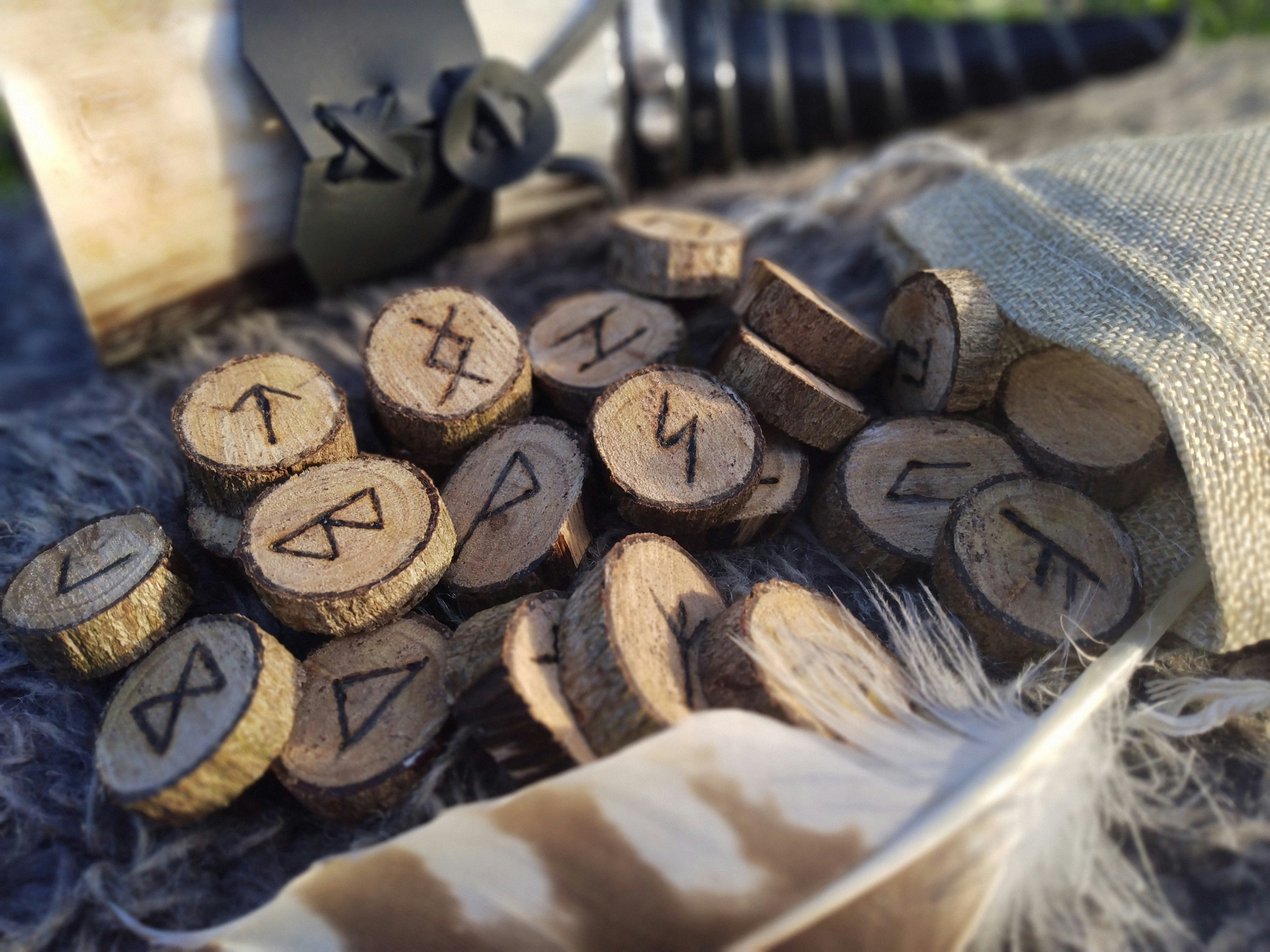
Have you ever found yourself looking for a sign — something that helps you make sense of what you’re feeling or facing? In our day-to-day lives, we often turn to words, numbers, or even music to interpret what’s going on inside us. Runes are another kind of language — one that speaks through symbols instead of sentences. Long before journaling prompts or oracle decks, people looked to these carved markings to find clarity, reassurance, and guidance.
Runes may seem mysterious at first, but they’re really a simple and ancient way of connecting with meaning. They remind us that symbols — whether written, drawn, or held in our hands — have always been how humans make sense of the world.
The Ancient Language of Runes
The word “rune” comes from an old Norse term meaning “whisper” or “secret.” Each rune represents both a sound and a concept, making it part of an ancient writing system as well as a tool for divination. The most commonly known system today is the Elder Futhark, a set of 24 runes used by early Germanic and Norse tribes.
These symbols weren’t just used for writing — they were carved into weapons, tools, stones, and jewelry, believed to hold protective or magical energy. Each symbol had layers of meaning: literal (as letters), metaphorical (as ideas), and spiritual (as energies or forces).
In essence, runes carried both communication and intention. They were not just letters — they were living symbols, used to call in energy, mark events, or seek wisdom from the unseen.
How Runes Were Used Then — and Now
Historically, rune readings were less about predicting the future and more about understanding the present moment. When a seeker cast or drew runes, they weren’t asking, “What will happen?” but rather, “What is happening, and what might I learn from it?” The runes acted as mirrors — reflecting inner truth and current energy.
Runemasters or wise people in the community often performed readings, but the practice wasn’t limited to them. Many ordinary people carried rune inscriptions or carved their initials with symbolic care, knowing that each letter carried weight.
Today, rune reading is experiencing a quiet revival. You don’t need to be a historian or a mystic to work with them. Modern readers use rune sets made from wood, stone, or clay — each engraved with the ancient symbols. A simple cloth or surface is used for casting, though many prefer to draw a single rune as a daily focus.
When you use runes, you’re not summoning spirits or channeling fate. You’re engaging in reflection through symbols. The process slows your thoughts, helps you notice patterns, and gives your intuition a shape to speak through.
Beginning Your Journey with Runes
If you’ve never worked with runes before, it can feel like stepping into an old library filled with books in another language. Start small. You don’t need to memorize all 24 symbols right away.
Begin by choosing or creating your own set. You can buy a simple set made of wood or stone, or even make your own with pebbles and a marker. What matters most is your connection to them. Before your first reading, take a few moments to hold each rune and look at its shape. Notice which ones you feel drawn to — there’s usually a reason, even if you can’t explain it yet.
A simple way to start is with a single-rune draw. Ask yourself something reflective, like “What energy surrounds me today?” or “What should I keep in mind as I move through this week?” Then pull one rune at random. Look up its traditional meaning and take note of how it feels relevant to your current situation.
Over time, you’ll start recognizing the runes like familiar faces. You might begin to see how each symbol represents an archetype — a universal human experience such as growth, endings, boundaries, or strength.
Bringing Runes into Everyday Life
Working with runes doesn’t have to be formal or ceremonial. In fact, they become most meaningful when you weave them into ordinary routines.
- Keep one rune in your pocket or wallet as a quiet reminder of its energy.
- Use runes as journaling prompts. Pull one at the start of your week and write about how its meaning shows up in your experiences.
- Mark a candle or a page with a rune symbol that represents what you’re calling in — maybe joy, protection, or direction.
You might notice that once you start working with runes, the symbols begin to show up in unexpected ways — in shapes, patterns, or even words that echo their energy. That’s part of the quiet magic of symbolic language: once you tune in, it keeps speaking.
Runes remind us that divination isn’t always about predicting the unknown; sometimes it’s about recognizing what we already know — but haven’t yet named.
A Modern Connection to Ancient Wisdom
In a time when we’re constantly surrounded by noise and data, runes bring us back to something simpler and quieter — a conversation between you and your intuition. They don’t demand belief, only attention.
When you take a moment to cast or draw a rune, you’re participating in a practice that connects thousands of years of human curiosity and creativity. It’s a small act of remembering: that language began as symbols, and that meaning is something we create together — across time, culture, and experience.So, the next time you’re feeling uncertain or searching for guidance, you might reach for your set of runes. Hold one in your palm. Let its symbol speak. You may find that the answer isn’t in the future — it’s right there in the simple geometry of an ancient line.